How to Protect Your Joints & Prevent Injury While Lifting Weights After Menopause
How to Protect Your Joints & Prevent Injury While Lifting Weights After Menopause
Sep 11, 2025
If you are post menopausal and want to feel stronger, steadier, and more capable, weight training is one of the best tools you can use.
Yet, many women hesitate. They worry about sore joints, past injuries, or the fear of “doing something wrong” in the gym.
The truth is that avoiding strength training altogether is a much bigger risk to your health than learning how to do it safely.
The Role of Joints and Muscles After Menopause
Menopause brings hormonal changes that affect bone density, muscle mass, and joint health.
Estrogen plays a protective role in joint tissue, and as levels decline, women often experience stiffness or pain.
Without strength training, the supporting muscles around the joints weaken, making everyday movements less stable.
Strong muscles act like scaffolding, reducing stress on joints and lowering the chance of injury.
Research-Backed Benefits of Strength Training Post Menopause
The science is clear: strength training not only builds muscle, it also helps protect joints and reduces the risk of injury.
- Exercise is now recognised as one of the most effective non-drug treatments for osteoarthritis, reducing pain and improving mobility (Bennell & Hinman, 2011).
- Systematic reviews show that structured exercise significantly reduces knee pain and improves function in women with osteoarthritis of the knee (Fransen et al., 2015).
- Group-based progressive strength training reduces recurrence rates of chronic low back pain while improving functional capacity (Steele et al., 2020).
- Neuromuscular-based exercise has been shown to improve both pain and range of motion in women with frozen shoulder compared to standard approaches (Wang et al., 2023).
These findings are consistent: when you move and strengthen the body, even during or after an injury, you recover better than if you stop moving altogether.
Common Problems with Traditional Approaches
Unfortunately, not all gyms and trainers get this right. Too often, women are pushed into lifting heavier weights too quickly or performing movements faster than their joints are ready for.
Some trainers even tell women to push through pain, which can worsen injuries rather than prevent them.
Group fitness classes can also be risky when they are unstructured or random.
Many offer little room for modification, leaving women to either push through discomfort or sit out exercises entirely. Both options limit progress and increase frustration.
How We Do Things Differently at The Evolved?
Many trainers get push happy with their clients, adding too much weight too soon or moving too quickly before strong foundations are built. Worse, some even tell clients to push through pain and discomfort.
Many group fitness classes are unstructured, random, and lack proper modification.
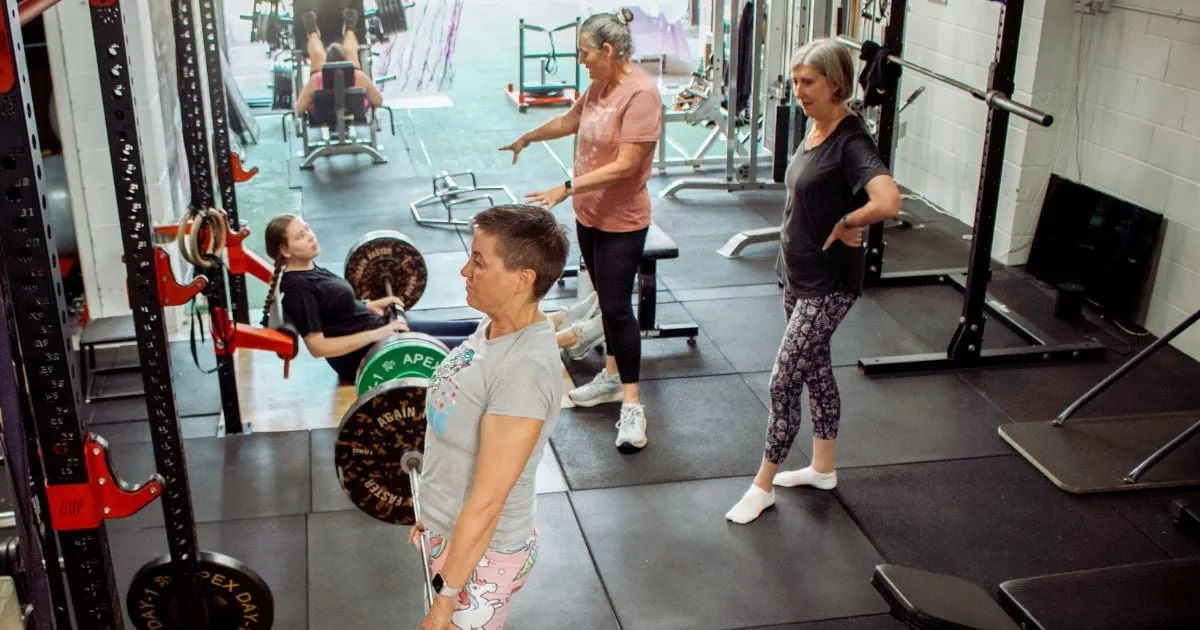
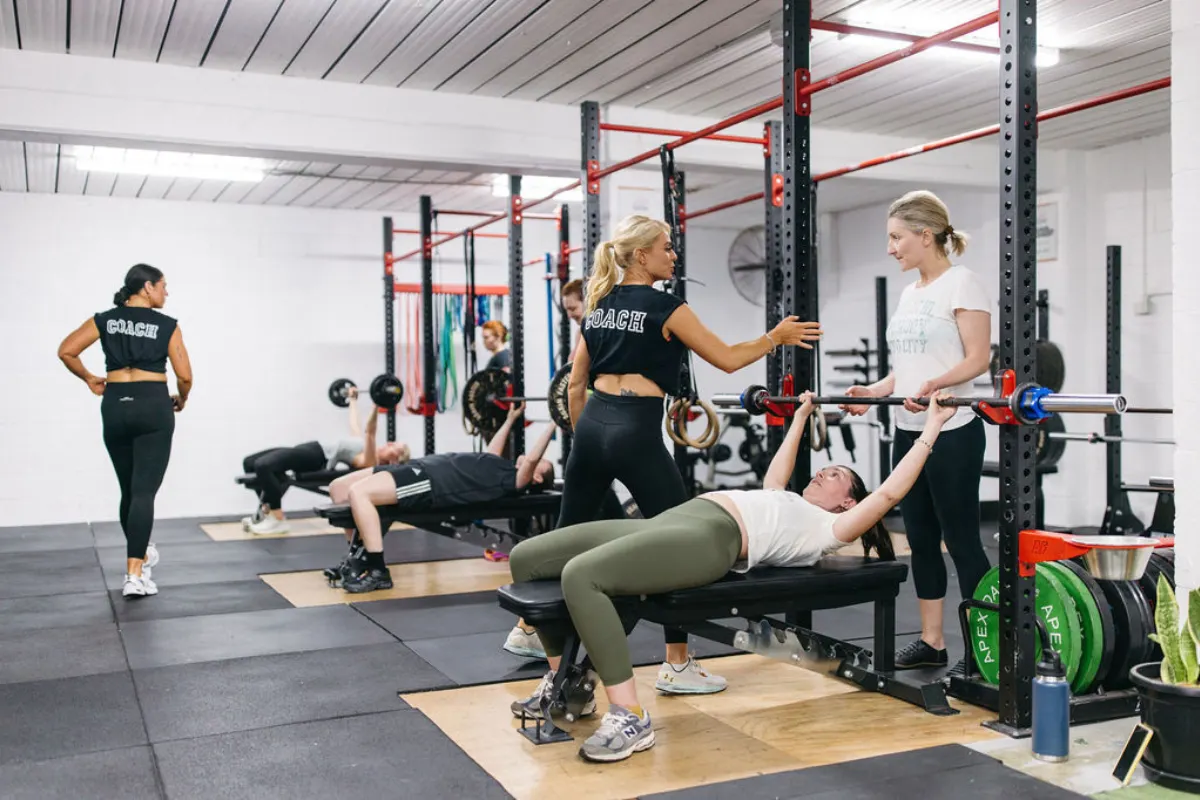
At The Evolved, we take a different approach. Our Sculpt & Strength and Evolve Strong classes are designed to be fully modifiable to meet you where you are.
Our trainers are specifically taught how to apply progressive overload safely, ensuring you can keep training for years without setbacks. Because the last thing you want is to get injured at the very place you trusted to help you thrive.
Protecting Your Joints in Practice
So what does safe and effective strength training actually look like for post menopausal women?
- Structured Warm-ups and Mobility Work: Preparing the joints and muscles with targeted mobility drills before lifting.
- Joint-Friendly Exercise Selection: Using controlled squats, presses, rows, and carries that build strength without excessive strain.
- Progressive Overload Done Right: Adding weight or intensity slowly and systematically, instead of rushing into heavier loads.
- Pain-Free Range of Motion: Adjusting movements so that they challenge you without aggravating existing injuries.
- Feedback and Communication: Working with trainers who listen and adapt programming to your body’s needs.
Next Steps for Women Ready to Train Safely
Strength training is one of the most powerful things you can do for your health after menopause. It protects your bones, supports your joints, and improves your confidence in everyday life.
But it needs to be done in a way that is structured, safe, and adaptable.
The earlier you start, the easier it is to build a foundation that will serve you in your 50s, 60s, and beyond.
If you already have a history of back pain, osteoarthritis, or shoulder injuries, the right program can be the difference between continued struggle and a strong, pain-free future.
Strength Assessment today.
Ready to train safely and feel stronger than ever? Book your Strength Assessment today.
We are currently full, but you can head to our main website and join the priority list.
Sometimes you may be lucky and see a calendar pop up on the next page. If it does, book immediately to secure your spot.
The sooner you start, the sooner you’ll feel stronger, steadier, and ready to thrive in this next chapter of life.
References
- Bennell, K. L., & Hinman, R. S. (2011). Exercise as a treatment for osteoarthritis. Journal of Orthopaedic & Sports Physical Therapy, 41(10), 712–719. https://doi.org/10.2519/jospt.2011.3549
- Fransen, M., McConnell, S., Harmer, A. R., Van der Esch, M., Simic, M., & Bennell, K. L. (2015). Exercise for osteoarthritis of the knee: A Cochrane systematic review. British Journal of Sports Medicine, 49(24), 1554–1557. https://doi.org/10.1136/bjsports-2015-095424
- Steele, J., Bruce-Low, S., Smith, D., Jessop, D., Osborne, N., & Tweed, M. (2020). Group-based progressive strength training reduces recurrence and improves function in chronic low back pain: A randomized controlled trial. International Journal of Environmental Research and Public Health, 17(22), 8326. https://doi.org/10.3390/ijerph17228326
- Wang, L., et al. (2023). Positive effects of neuromuscular exercises on pain and active range of motion in idiopathic frozen shoulder: A randomized controlled trial. BMC Musculoskeletal Disorders, 24, 61. https://doi.org/10.1186/s12891-023-06173-8