How to Build Strength & Maintain Muscle in Your 40s A Perimenopause: Smart Strength Guide
How to Build Strength & Maintain Muscle in Your 40s A Perimenopause: Smart Strength Guide
Aug 22, 2025
Lifting weights builds muscle, protects joints, and keeps your metabolism responsive.
If you have not focused on strength training before, starting in your 40s can preserve lean tissue, improve energy, and set you up for a stronger next decade.
At The Evolved All Female Gym, we coach women in their 40s who want a clear, evidence-based path to keep and build muscle through perimenopause. Here is why strength training matters now, and how to begin safely.
Why Your 40s Are a Pivotal Decade for Muscle and Strength
Science is clear: women naturally lose 3 to 8 percent of muscle mass every decade after 30. The loss can accelerate after 50. As hormones begin to fluctuate in your 40s, recovery may feel slower, sleep can change, and body composition can shift more easily toward fat gain if you are not lifting.
This is why many women notice:
- Slower metabolism and easier weight gain
- Stiffness or joint niggles after sitting or stress
- Strength loss in everyday tasks
- Lower training confidence after time away from the gym
- The good news is that focused strength training directly counters these changes.
What the Research Says About Peri-menopause Training
A 2023 clinical trial on women aged 40 to 60 found important results:
All women improved strength when they lifted free weights.
Low-volume programs were more effective for building muscle in pre-menopausal women than in post-menopausal women.
As women transition toward and beyond menopause, meaningful body composition change requires sufficient training volume and intensity.
Translation for your 40s: train consistently with compound lifts, progress one small step at a time, and work at an effort that challenges your muscles while your form stays controlled.
Pilates, Yoga, and Walking: Helpful for Health, Not Enough for Muscle
Pilates, yoga, and walking can improve mobility, balance, breath, and cardiovascular health. Many women feel better when they do them, which is a win.
The nuance is this: these activities typically do not provide the level of mechanical tension, progressive overload, and proximity to fatigue required to build or preserve significant muscle mass.
During peri-menopause you can still build muscle with moderate volumes when the effort is high enough.
As you move past menopause, research shows the threshold for change rises. In practice that means you need higher volume and intensity than before.
If your training is mostly lower load and lower effort, you will feel fit but you will not keep as much muscle as you could.
Training With Intensity Is a Skill: Start Building It Now
Being able to train at the intensity required to maintain muscle after menopause is not just about willpower. It is a technical and psychological skill that is best developed over years with good coaching and consistent practice. Expecting to start strength training after menopause and immediately get the full benefit is unrealistic for most women.
The skill of lifting with effective intensity looks like:
- Precise set up and bracing so joints feel stable while muscles do the work
- Using full ranges you can control and pausing when needed to keep tension
- Selecting loads that make the last 1 to 3 reps challenging while technique stays clean
- Tracking sets and reps so you can progress weight, reps, or tempo over time
- Taking planned de-loads so you recover and keep improving
Perimenopause is the ideal window to learn these skills.
You are likely to respond faster now than later, and what you build in your 40s becomes the base that protects your muscle, bones, and confidence in your 50s and beyond.
Benefits of Strength Training in Your 40s
Strength training is more than just lifting weights. Done correctly, it helps you:
- Maintain and build lean muscle: preserves shape and strength
- Protect joints and posture: stabilises knees, hips, shoulders, and spine
- Support bone density: lowers long-term fracture risk
- Boost metabolism and energy: more muscle means more calories burned at rest
- Improve balance, coordination, and confidence: makes daily movement easier
- Sharpen mood and mental clarity: supports stress resilience
How to Start Safely During Perimenopause
If you are returning to training or starting fresh, use these steps:
Book a Strength Assessment
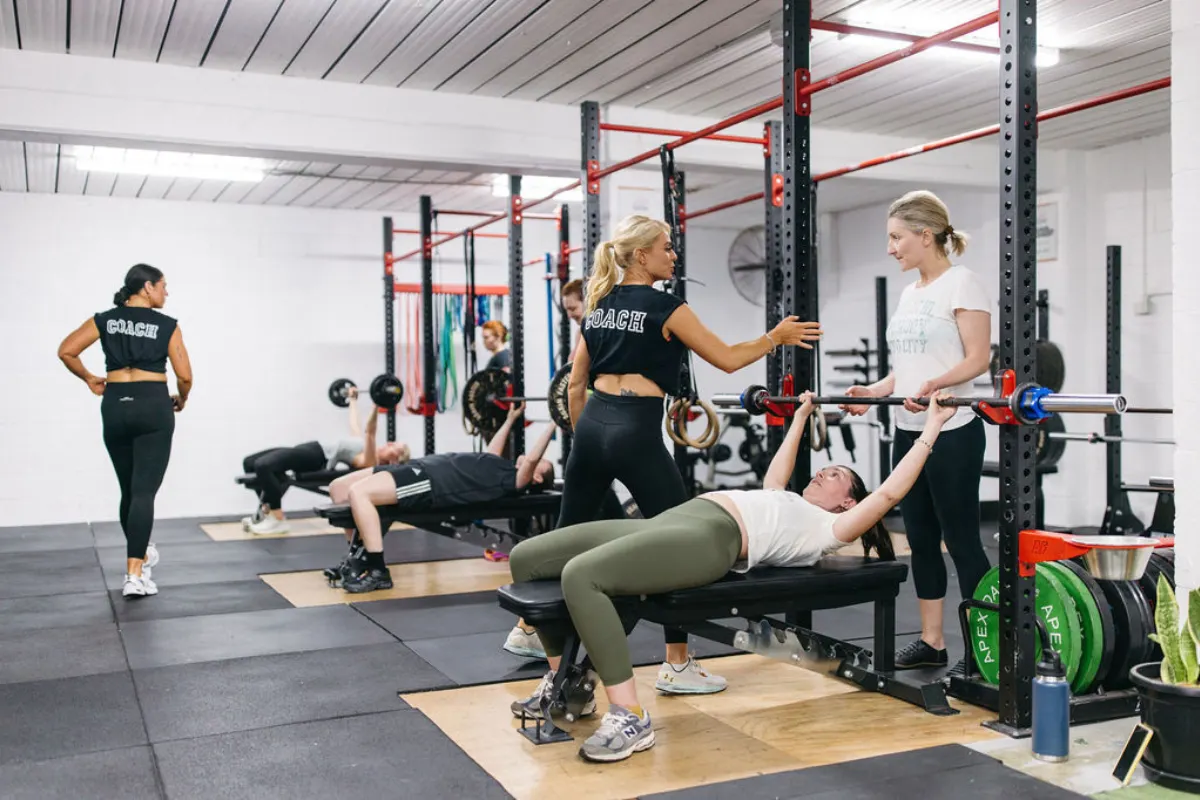
Every woman has a different starting point. We assess mobility, movement quality, and current strength so your program is safe and tailored.
Start With the Basics
Prioritise compound movements such as squats, hinges, pushes, pulls, and carries. These give the best return for muscle, joints, and bones.
Progress Gradually
Increase one variable at a time: add a small amount of weight; or add a rep; or add a set; or slow the tempo. Keep your last 1 to 3 reps challenging but controlled.
Focus on Recovery
Muscle grows between sessions. Aim for consistent sleep, adequate protein across meals, and planned deloads when you feel run-down.
Why Train With The Evolved All Female Gym
- Women only: a safe, supportive environment
- Science-backed programming: designed from research, not trends
- Expert female coaches: specialists in perimenopause and women’s strength
- Community: surrounded by women on the same journey
Ready to Build Strength and Maintain Muscle?
You do not have to figure this out alone. At The Evolved, we help women in their 40s build confidence, strength, and a repeatable routine that fits real life.
Book your Strength Assessment today.
We are currently full, but you can head to our main website and join the priority list. Sometimes you may be lucky and see a calendar pop up on the next page. If it does, book in immediately.
The sooner you start, the sooner you will feel stronger, more energetic, and fit for life.